
The idea in brief
The problem. AI adoption is nearly universal, but most of that activity isn't converting into measurable business impact.
The insight. AI becomes valuable when the operating model changes around it: the workflows, decision rights, roles, data, governance, adoption, and measurement through which work gets done. One of those does more work than the rest. Where AI changes what can be known, and no one changes who is authorized to act on it, the other six rarely convert.
The implication. Leaders should concentrate AI investment on the few business levers that matter most, redesign the work around them, and assign the decision rights so value can compound.
AI is everywhere in the enterprise now. Value is not. Closing that gap is the work of the next three years.
There is a conversation I keep having with senior leaders. It usually starts the same way: "We're spending real money on AI. The demos are impressive. The team is excited. And the business case is starting to feel thin."
The evidence now tells a consistent story:
- 88% of organizations now use AI in at least one business function (McKinsey, November 2025).
- ~6% qualify as what McKinsey calls AI high performers: organizations that report significant value from AI and attribute at least 5% of EBIT to it.
- 42% of companies reported abandoning most of their AI initiatives, up from 17% a year earlier, with the average organization scrapping 46% of proofs of concept before production (451 Research / S&P Global, fielded late 2024, published October 2025).
- 20/74 In PwC's 2026 survey, 20% of organizations accounted for 74% of the reported AI-driven economic value (PwC, April 2026).
- 7.2x The most AI-fit companies reported 7.2 times the AI-driven revenue and efficiency gains of the average competitor, with profit margins four percentage points higher (PwC, April 2026).
One number is missing from that list on purpose. The widely quoted claim that 95% of enterprise AI pilots produce no return comes from a preliminary, non-peer-reviewed paper based on 153 survey responses. It may be directionally useful, but it does not meet the evidence standard I am applying here. I have therefore left it out.
Read those figures side by side and a pattern emerges that should reframe every AI conversation in the C-suite. The gap is not between companies that have AI and companies that do not. Nearly everyone has it. The gap is between companies that have converted capability into value and the overwhelming majority that have not. And that gap is widening. PwC's researchers are blunt about the trajectory: without a change in approach, the leaders keep pulling away, learning faster, scaling what works, and automating decisions safely, while everyone else stays stuck in pilots.
Here is the thesis I have come to hold with conviction, earned across more than two decades of leading transformation: AI does not become valuable when it is built. It becomes valuable when the operating model changes around it. By operating model, I mean how the work of the business actually gets done: the workflows people follow, the decisions they make and who is authorized to make them, the roles they play, the data they rely on, the rules that govern the work, and the behaviors that carry it. That is the definition I will use throughout, because it is where AI value is won or lost. Of these, in my experience, decision rights are the load-bearing element. Every other change runs through them.
It is also worth being precise about the word in this brief's title. AI is real when it produces measurable, sustained change in business or human outcomes: better decisions, fewer errors, less delay, lower cost, greater capacity, and clear accountability for the results. Pilots, licenses, demos, and adoption statistics are activity. Activity is not value. AI is real when the outcome changes, and someone owns it.
As AI moves from copilots toward more autonomous, agent-based capabilities, systems able to carry out multiple steps of a workflow within boundaries the organization sets, the leadership challenge does not change. Value does not come from the technology alone. It comes from redesigning the operating model around it.
The companies that pull ahead over the next three years will treat AI as an operating discipline, not a technology program.
This is not merely a point of view. It is what the evidence now shows. When McKinsey tested the organizational practices associated with AI high performance, workflow redesign stood out as one of the strongest contributors to bottom-line impact: high performers are nearly three times as likely as everyone else to have fundamentally redesigned individual workflows when deploying AI. Not model selection. Not vendor strategy. Not headcount devoted to AI. One of the clearest predictors of impact is whether the company changes how the work itself flows. PwC frames the same idea as an allocation: in its 2026 predictions, roughly a fifth of an AI initiative's value comes from the technology, with the remainder coming from redesigning the work around it, the workflows, the adoption, the governance, and the measurement. That split is an estimate rather than a measurement, and it is best read as a statement of where the effort belongs.
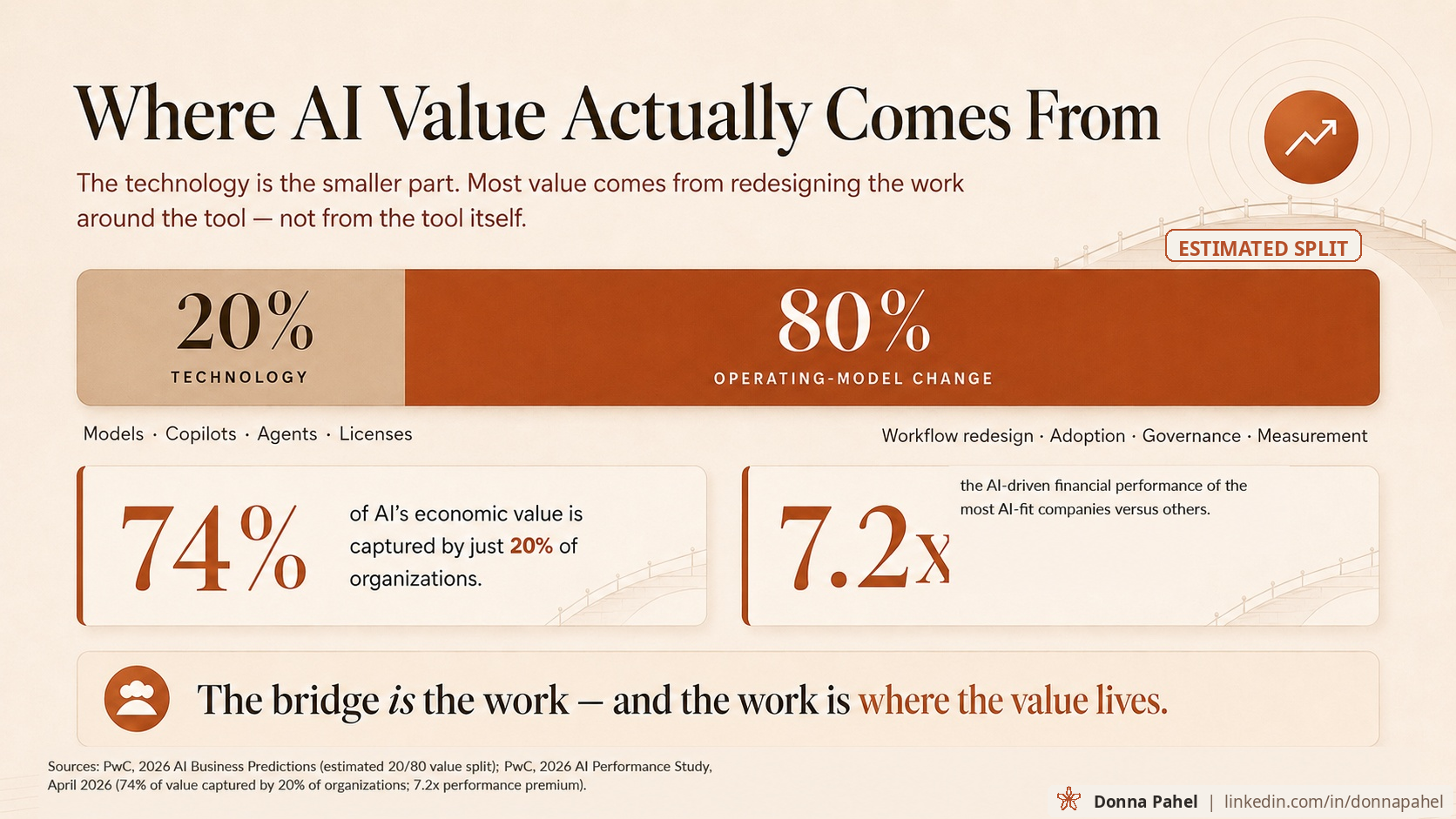
PwC's research also points to a broader performance premium behind that 7.2x figure: it reflects the gap between companies with the strongest overall "AI fitness," spanning strategy, investment, data and technology, workforce, governance, and innovation together, and everyone else. Workflow redesign is one part of that discipline, not the whole of it.
The simplest way to see the problem is as an underbuilt bridge between capability and value.
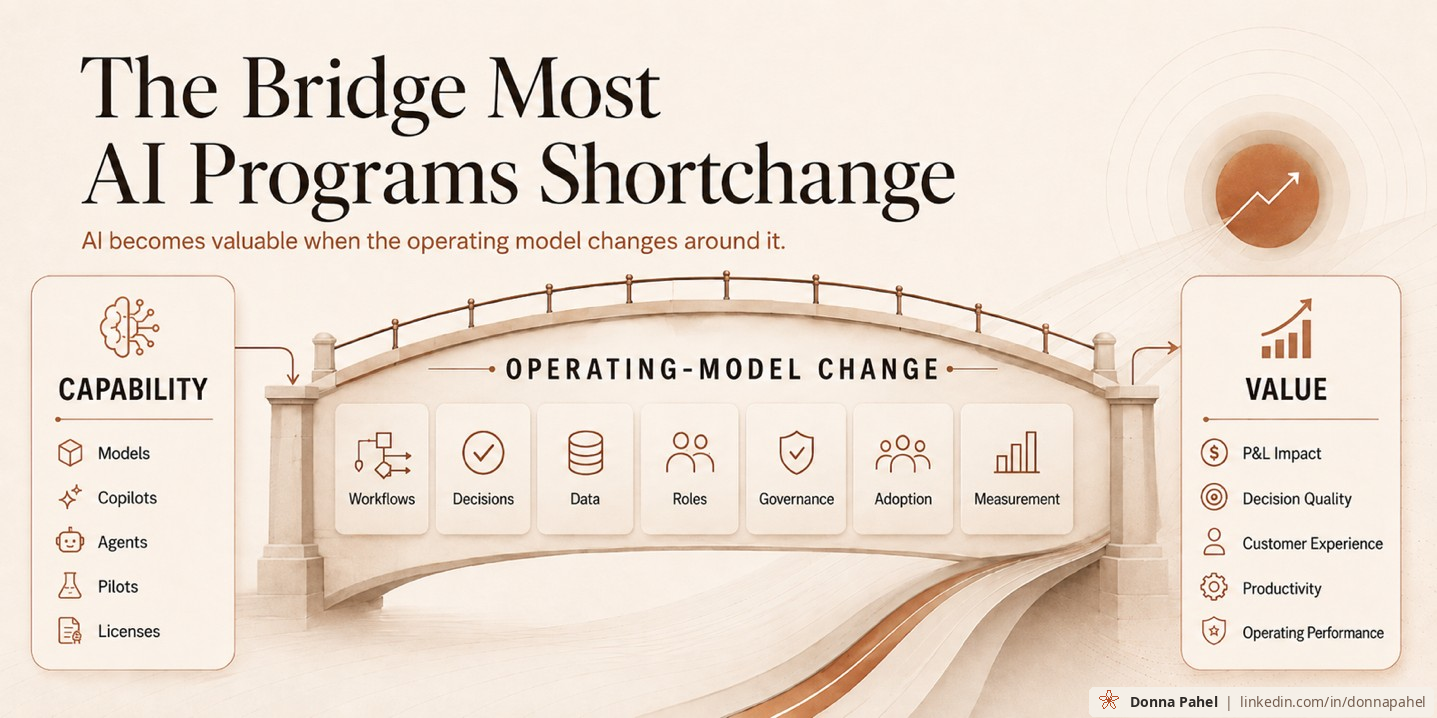
The Bridge Most AI Programs Shortchange
Picture the AI journey as three stages. On one end sits capability: models, copilots, agents, pilots, and licenses. On the other end sits value: P&L impact, decision quality, and customer experience.
In between sits the bridge: operating-model change. It is the bridge most AI programs shortchange.
Why does it get shortchanged? Because the two ends are easier. Buying capability is a procurement exercise. Declaring value is a communications exercise. Changing the operating model is harder. It requires the cross-functional work of redesigning how decisions get made, who is accountable for what, and what people do on Tuesday afternoon. It does not demo well. It rarely makes the town hall slide. That is where AI starts becoming real in the business.
The research points to a more useful diagnosis than technology versus organization. Technical capability matters, but so do workflow design, leadership ownership, trust, skills, adoption, governance, and where the technology is applied. The organizations converting more capability into value are not simply choosing better tools. They are changing more of the system around them.
Five Patterns That Keep AI Investment from Compounding
Across enterprises moving from AI ambition to business impact, these five patterns tend to show up when AI investment is active but value is not yet compounding. Technology may be part of the constraint. But the operating discipline around it is often underbuilt too.
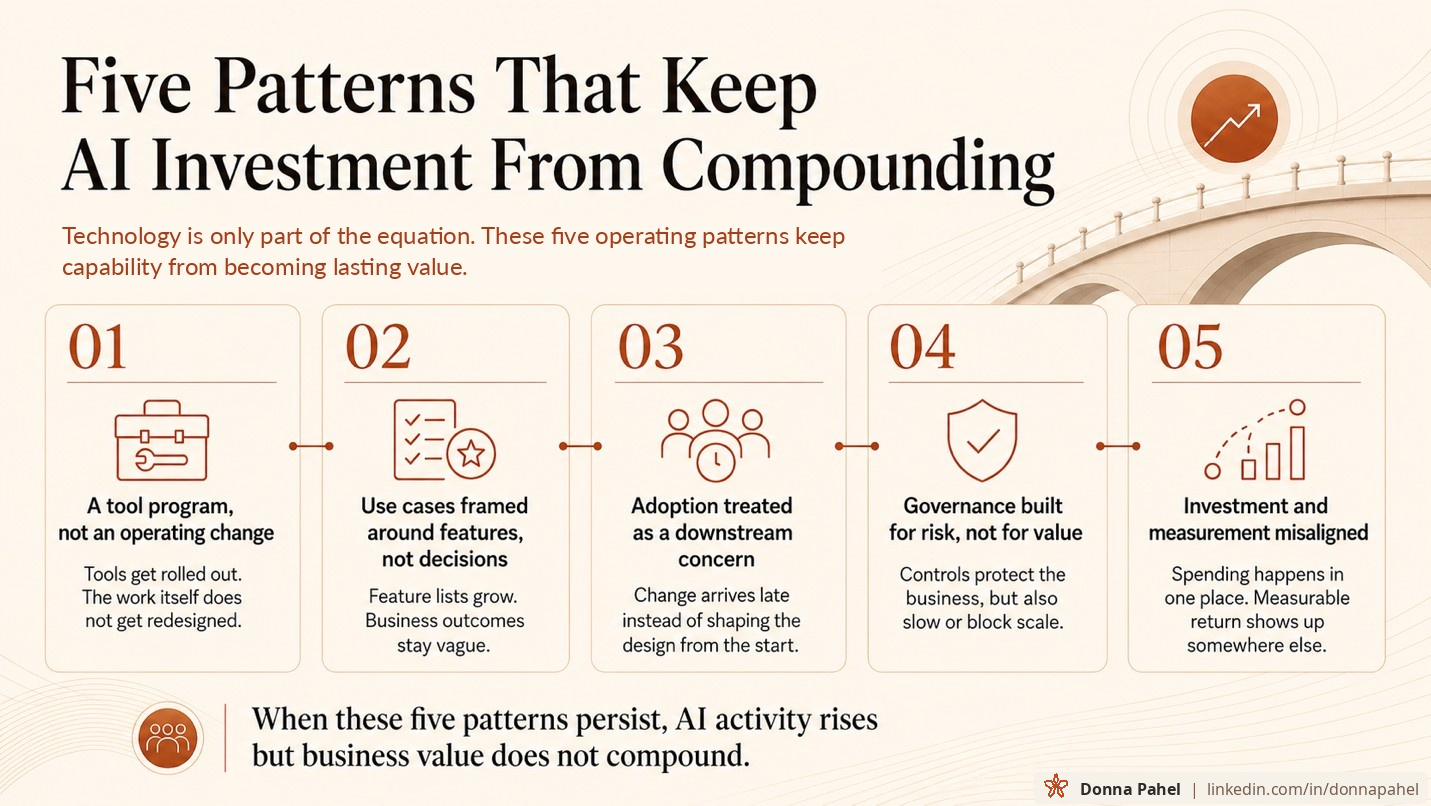
These patterns are less about AI maturity than operating maturity. They reveal whether the organization has changed the work around the technology or merely introduced the technology into existing work.
- AI is treated as a tool program rather than an operating change. Tools get rolled out. Operating models do not get redesigned. A remarkable number of companies are doing the first and calling it the second. Licenses sprawl, usage dashboards glow green, and nothing fundamental about how the business runs has shifted.
- Use cases are framed around features rather than decisions. "Summarize meetings" is a feature. "Reduce credit-decision cycle time by 40%" is an outcome. The first kind of list produces adoption metrics; the second produces P&L impact. Many of the highest-value applications of AI are not about doing work faster at all. They are about making better decisions at the moments where decisions shape outcomes: pricing, underwriting, claims, inventory allocation, workforce planning. The market itself is now confirming the distinction. In Futurum Group's first-half 2026 survey of 830 enterprise IT decision-makers, direct financial impact nearly doubled, to 21.7%, as the primary measure of AI return, while productivity gains fell from 23.8% to 18.0% as the leading success metric. Buyers, in other words, are shifting the question from features to financial impact.
- Adoption is treated as a downstream concern. By the time change management gets the work, the operating-model questions are months past the point where they could have shaped design. This is backwards. Human adoption is a value creation mechanism, not a change-management workstream. The companies that treat it that way realize more value, faster, with less risk.
- Governance is built for risk but not for value. Defensive governance is necessary but insufficient. When governance only protects, it ends up gating the very value it was meant to enable. Done well, governance has a value job: it decides who may act, on what evidence, with what oversight, and it makes responsible AI use the path of least resistance for the business. This pattern matters enough that it gets its own section below.
- Investment and measurement are misaligned. Spending concentrates where AI is most visible; measurable return tends to show up somewhere less glamorous. The measurement gap is not subtle: in the Thomson Reuters Institute's 2026 survey of more than 1,500 professional-services practitioners across 27 countries, only 18% of organizations were tracking AI's return in any meaningful way.
Add the patterns up and the diagnosis is clear: in many organizations, AI investment is not falling short because capability is absent. It is falling short because the operating model around it has not changed enough.
Where Durable Value Actually Lands
Generating AI ideas is not the hard part. Every organization has a backlog longer than its capacity. The hard part is concentration.
Durable AI value tends to land in six places: growth, productivity, decision quality, customer experience, workforce capacity, and operating performance. The point is not to pursue all six equally. The point is to identify which two or three would most change the economics, experience, or operating performance of the business.
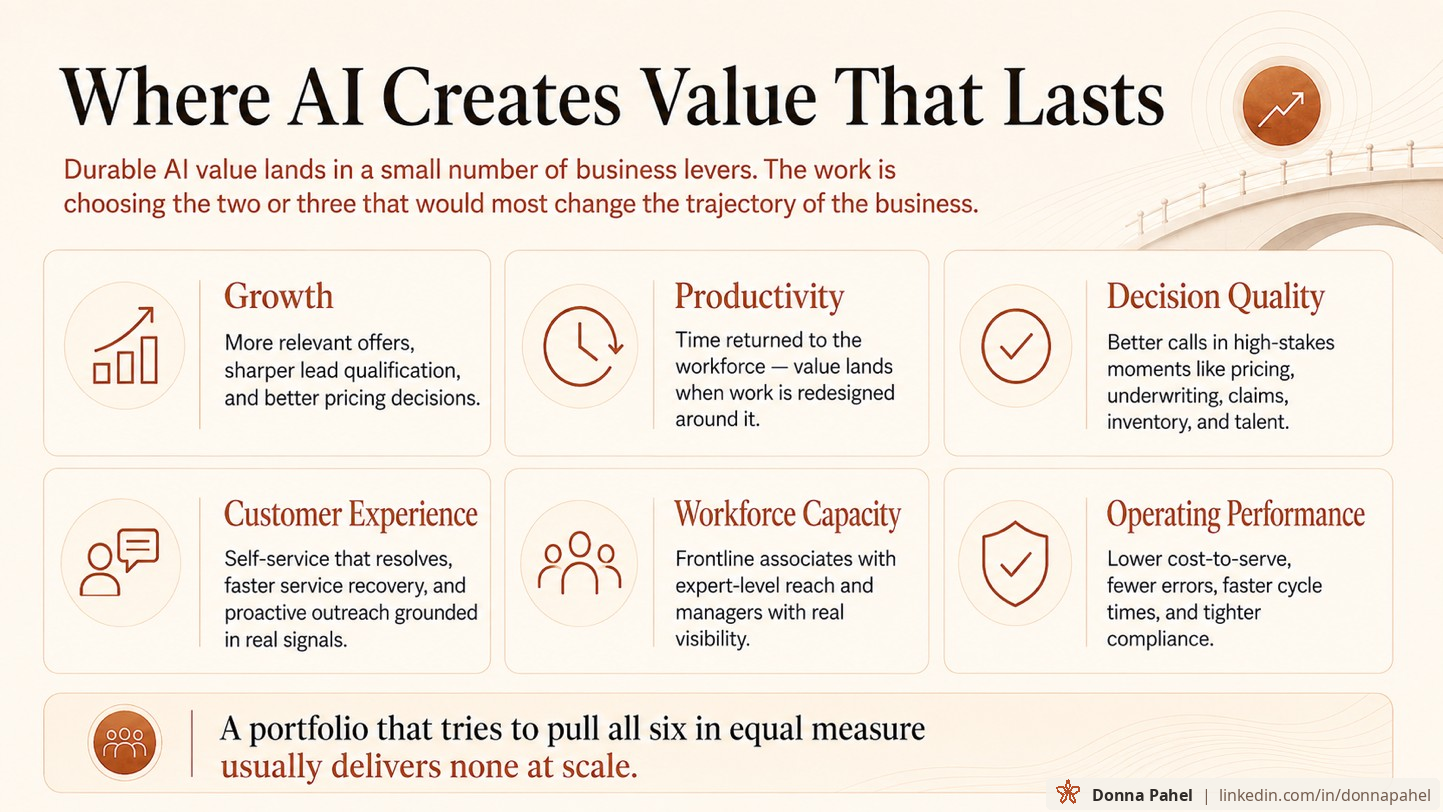
The leadership task is choosing the two or three levers that would most change the trajectory of the business, then having the discipline to deprioritize the rest. A portfolio that tries to pull all six in equal measure usually delivers none of them at scale. McKinsey's data supports the concentration instinct: high performers are far more likely to pursue transformative change with AI, and nearly three times as likely to fundamentally redesign workflows when deploying it. PwC's 2026 study sharpens the aim: the companies capturing the most AI value point it at growth and new revenue, not efficiency alone.
A Diagnostic Worth Running
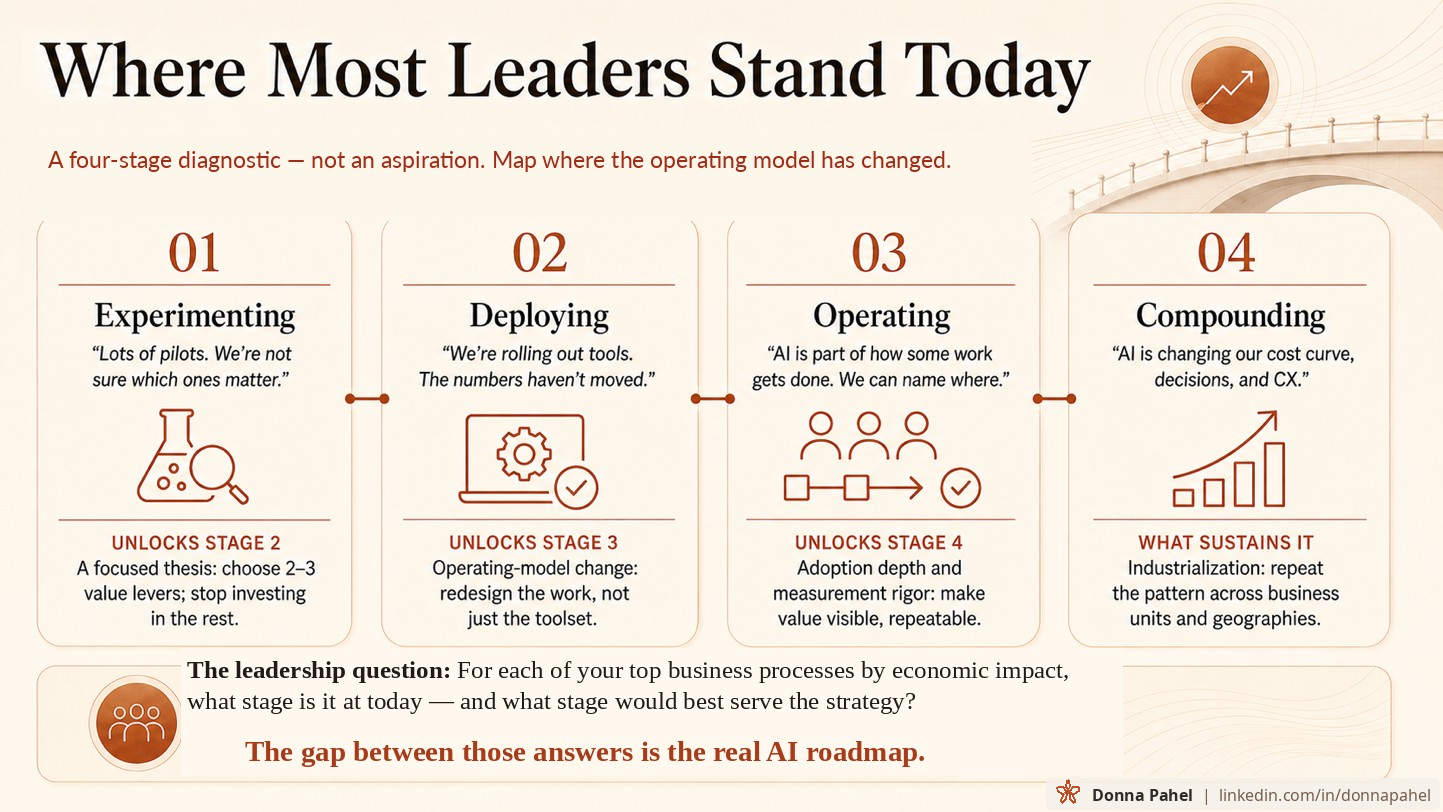
Where does your organization stand? Four stages describe almost every situation I encounter. The useful distinction is where the operating model has changed, not simply where AI tools have been introduced. A company may be experimenting in one part of the business, operating in another, and compounding in a third.
The leadership question is simple: for each of your top business processes by economic impact, what stage is it at today, and what stage would best serve the strategy?
The gap between those two answers is the real AI roadmap.
This Is a C-Suite Problem with a CIO Partner
A corollary of this thesis is that AI value creation cannot be delegated. It is not a CIO problem with C-suite support. It is a C-suite problem with a CIO partner, because the operating model is owned collectively or not at all. PwC's 2026 AI predictions call out a common mistake: crowdsourcing use cases from the bottom up and hoping a strategy will emerge from the pile. It rarely does. Adoption numbers climb; the business case does not.
| Leader | Value role |
|---|---|
| CEO | Sets the AI value thesis, names where AI matters most, and protects focus. |
| CFO | Owns the economics, value measures, and trade-offs from day one. |
| COO | Selects and redesigns the work where AI can change cost, cycle time, quality, or capacity. |
| CIO / CTO | Makes the stack portable, observable, secure, and governed by default. |
| CHRO | Treats adoption as value creation through role design, manager readiness, and AI fluency. |
| Risk & Compliance | Partners from the start on design: acceptable outcomes, decision boundaries, evidence requirements, and escalation paths that make responsible scale possible. |
McKinsey's data underlines the point about ownership. High performers are three times more likely than their peers to strongly agree that senior leaders demonstrate ownership of and commitment to AI initiatives, and that those leaders are actively engaged in driving adoption, including using the tools themselves. Sponsorship is not the same as ownership. The distinction shows up in the results.
Governance Is How AI Earns the Right to Scale
Governance deserves its own section, because it is the part of the operating model most often mistaken for paperwork.
Too much AI governance today is really risk management wearing a broader title: model reviews, usage policies, approval checklists. That work is necessary. It is not the whole job. Governance, properly understood, is the system of decision rights around AI, the explicit answers to a short list of questions that every consequential deployment raises:
- Who may authorize an AI-supported action, and who owns the business or human outcome that follows?
- Which decisions remain human, and when is human review required?
- Who may pause, override, or shut the system down, and who monitors performance after deployment, not just before it?
- What evidence is required before a capability moves from pilot to scaled use, or before its autonomy expands?
- Who answers when results differ from expectations, and who owns the remediation?
If those questions have no owners, the organization defaults to one of two failure modes. The first is drag: valuable capabilities sit trapped in pilots because no one is clearly authorized to scale them, and not deciding becomes the rational default. The second is overshoot: capabilities are deployed faster than the organization's judgment, controls, and capacity to respond. Drag wastes the investment. Overshoot spends trust the business cannot easily earn back. Both are governance failures, and both are expensive.
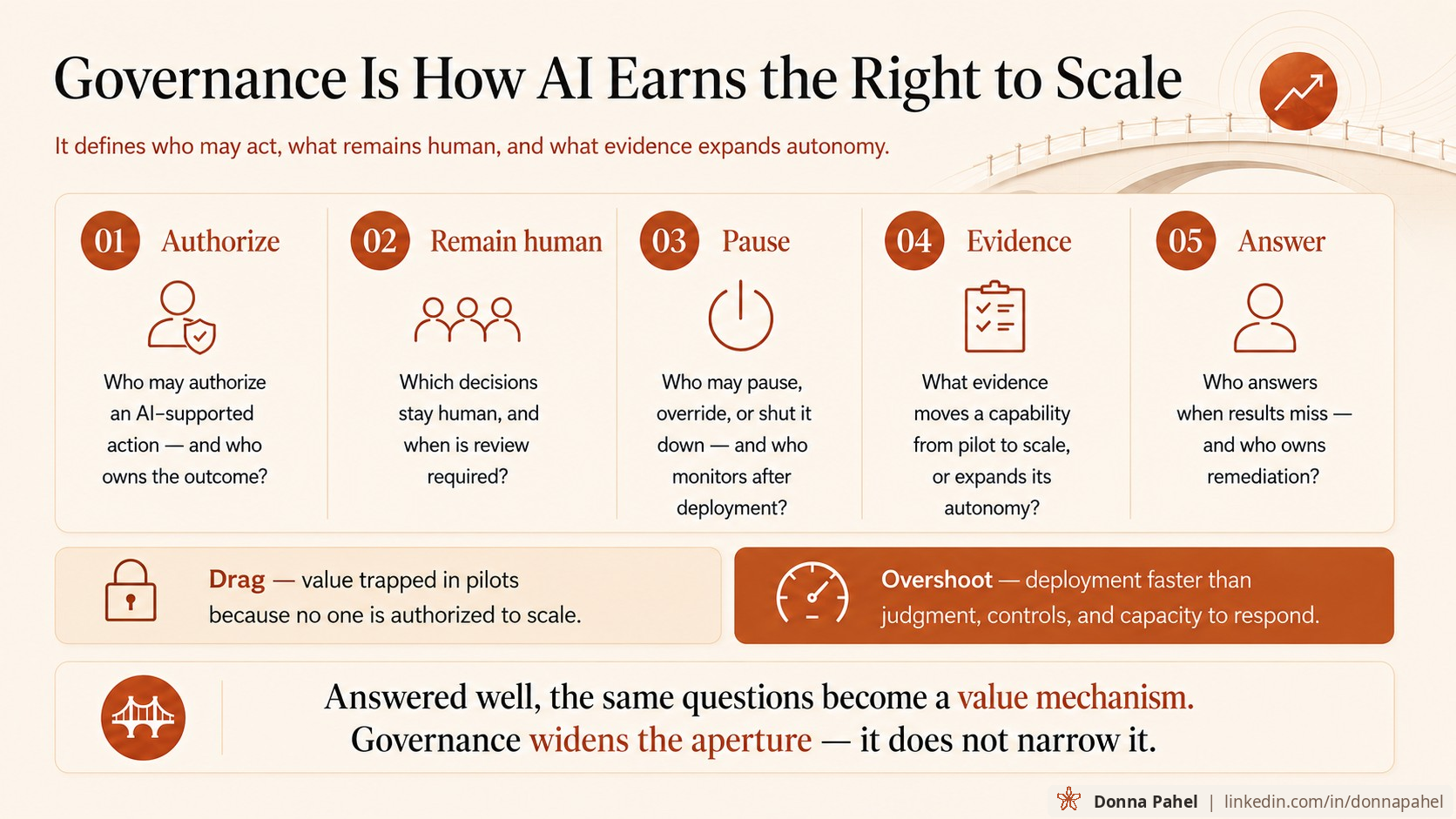
Answered well, the same questions become a value mechanism. Clear decision rights let leaders move faster with confidence, because the boundaries of safe action are known in advance rather than negotiated in a crisis. They are also what allow autonomy to expand responsibly: as AI takes on more steps of the work, authority and accountability must be reassigned deliberately, on evidence, or they will be reassigned by accident. PwC's 2026 study shows the leading companies doing exactly this. They run more of their AI in autonomous modes and permit more decisions without human intervention, not because they govern less, but because structured, responsible governance has earned their people's trust in the outputs. Governance is what widens the aperture, not what narrows it.
This is also why Risk, Compliance, Legal, Security, Privacy, and Audit belong at the design table, not the approval gate. Brought in early, these functions help define acceptable outcomes, set decision boundaries and evidence requirements, design escalation and rollback paths, and determine what must be monitored in production. That is not control at the expense of innovation. It is the work that makes responsible scale possible, the work that turns governance from the function that says "not yet" into the function that says "here is how."
Which is why governance cannot be delegated any more than value creation can. Decision rights over consequential, AI-supported action are a C-suite responsibility. The technology will keep getting more capable. The question that determines whether capability becomes value is who may decide, and whether anyone has earned the right to scale it.
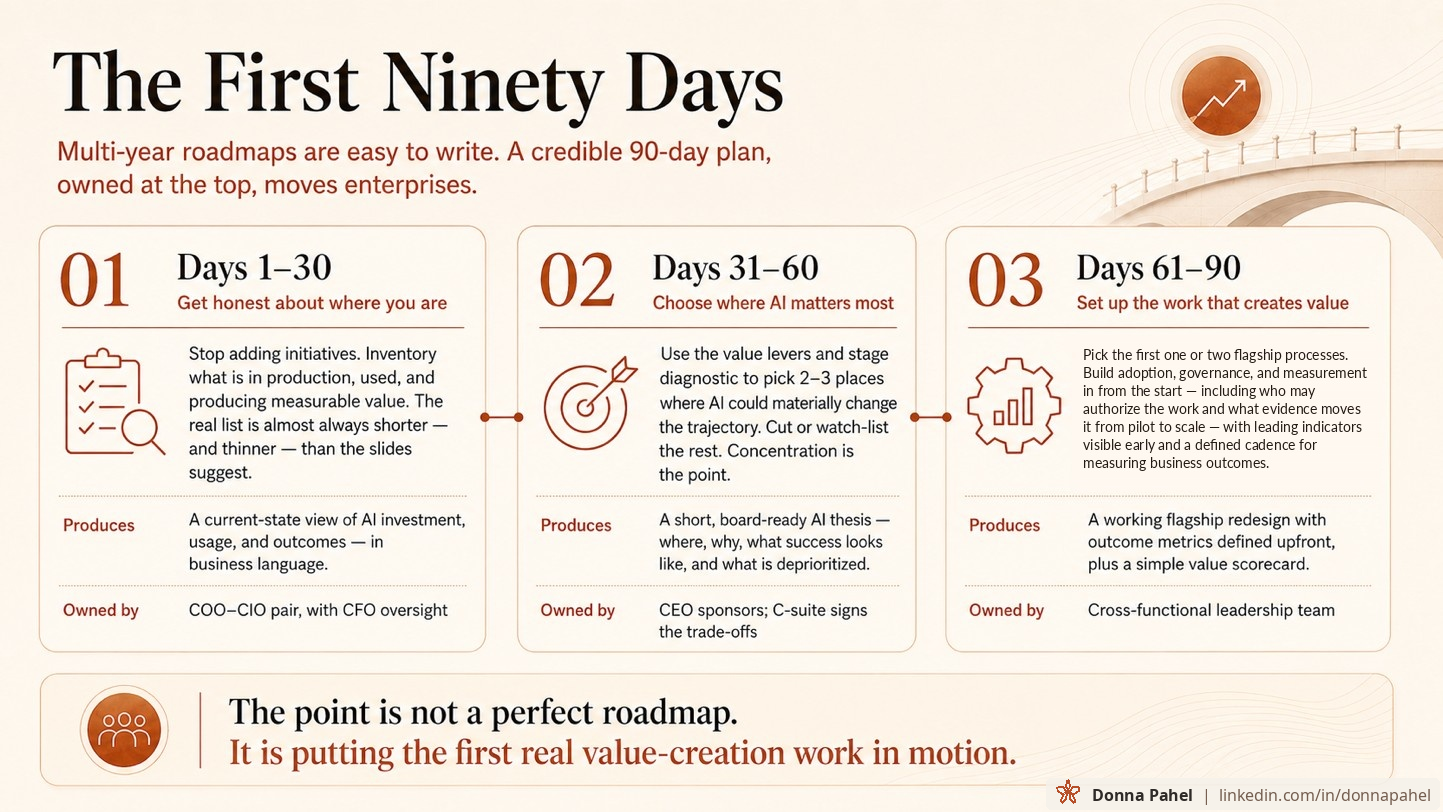
The First Ninety Days
Multi-year AI roadmaps are easy to write and hard to act on. What moves enterprises is a credible 90-day plan, owned at the top.
The Work That Matters Now
The leaders I work with already know, at some level, what is and is not working in their AI programs. They sense when the pilots are not adding up. They can feel when the value case is thinner than the deck suggests. That is not failure. It is a useful signal.
The next move is not to chase more activity. It is to get clearer about where AI can matter most, what work must change, who needs to own the change, and how value will be measured.
The research points in the same direction. Value does not show up in the model card or the demo. It shows up when companies redesign how work flows, how decisions get made, how people adopt new ways of working, and how governance enables responsible scale.
The path to AI value is not mysterious. It is hard, cross-functional, deeply human work.
That should be encouraging. The work is demanding, but it is knowable. It can be led. It can be designed. It can be measured. It can be improved.
AI ambition is everywhere. Business reality is harder. But the space between them is not a gap to fear. It is a leadership opportunity. For organizations ready to move from AI activity to operating impact, the work starts here:
- Choose where AI matters most.
- Redesign the work around it.
- Build adoption, governance, and decision rights in from the start.
- Measure what changes, and own the result.
Sources
- McKinsey & Company / QuantumBlack, The State of AI in 2025: Agents, Innovation, and Transformation, November 2025.
- S&P Global Market Intelligence / 451 Research, "Generative AI shows rapid growth but yields mixed results," October 27, 2025.
- PwC, 2026 AI Performance Study, April 2026.
- PwC, 2026 AI Business Predictions.
- Thomson Reuters Institute, 2026 AI in Professional Services Report, February 2026.
- The Futurum Group, 1H 2026 Enterprise Software Decision Maker Survey Report, February 2026.